Facets resin technique
 by
by Let's now look at the technique on the resin faces. What is the difference between resin veneers and a simple filling? We asked dentist Tania Hatzipanagiotidou about resin veneers technique and we present the answer in the article and in the embedded video.
Mrs Chatzipanagiotidou, resin facings are a simple sealing and if not what more does it offer?
Difference between resin faces and simple sealing
The resin face no is not a simple filling. Neither the material used in resin veneers nor the technique used is equivalent to a seal. Yes, resin is used in both cases. But the resin of the simple seal has a different microstructure than the resin to be used in the resin face. Resin veneers are a very specialised process. It takes specialization by the dentist and very specific equipment that needs to be in place. Only with these specifications can one say that you have indeed made a resin veneer and not just a simple filling that will somehow improve the appearance of my tooth.
Resin facets
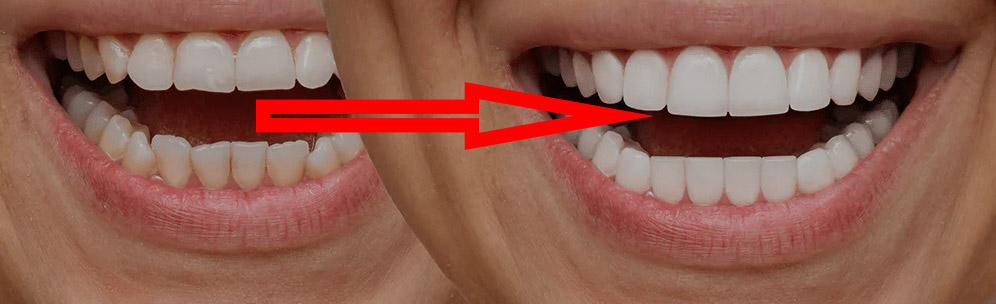
What it consists of the resin look; During the resin veneering technique it must be said that we do not remove dental substance from the tooth except in very few cases. To decide to put resin veneers on my teeth means that I am not satisfied with their shape and colour. I want to correct any discoloration that may be present that I want to cover I want to change.
Resin facings technology
The technique is as follows: First of all, we use state-of-the-art materials to which porcelain grains have been added. These are the latest materials available in dentistry. The process of resin veneering is layered. That is, when placing resin veneers, I first cover the outer surface of my tooth with a material that will block the color underneath. And that way I can then play with whatever color I want on top. So at the beginning I put on a very thin layer that blocks the colour of my natural tooth and which is extremely hard. In recent years, the materials used for the first layer, the covering of the tooth surface, have become too hard. This is different from normal filling. The materials on the resin veneers are extremely hard, so I can change both the shape and length of my teeth without fear of them breaking more easily and so on.
Layers when laying resin facings
So, at the beginning this layer is put in. Along the way, a layer will be added to give me the transparency of the bottom surface of the tooth and the sides to make it more like a natural tooth. Because natural teeth have transparencies and they are also layered, meaning that one material in a natural tooth is in the core of the tooth, another on the side, another on the top. This is what we are trying to imitate with the technique of resin veneers. So, after the second layer, a third layer is put on the surface which will give me the final colour of the resin veneer. I do all of this in the shape I have chosen to use.
Polishing of resin faces
And in the end we use very specific materials for the very, very good polishing of the resin. This polishing plays a very, very big role in preventing the resin appearance from being easily pigmented. The polishing also plays an important role in making it last for many years. So no, there is ultimately no connection between a resin face and a simple filling. Even with a simple resin you could say that I am adding on and improving your smile a little bit.
Placement of dental implants
Dentist Tania Hadjipanagiotidou has experience in dental implants with more than three thousand procedures in her practice. Dental implants are a top choice for covering missing teeth. If tooth loss occurs then the best option is to place a tooth implant in its place. With tooth implants, autonomous teeth are placed in place of the lost teeth. Over time, tooth implants assimilate into the bones of the mouth and are indistinguishable from the normal teeth. In simple terms the dental implants are titanium screws that are placed in the location of the missing tooth. They are artificial tooth roots that are surgically placed in the jaw to support a prosthetic restoration. Titanium is a biocompatible material that naturally integrates with the bone.
Why choose dental implants
Tooth implants are used to cover tooth loss. The reason why we choose dental implants is the many advantages they have. The result of placing dental implants offers a natural look and feel. Tooth implants are similar to natural teeth. They are very durable and with proper care can last for many decades. A very important advantage of tooth implants is that they do not cause any modification of the adjacent teeth. We don't mess with the adjacent teeth as is the case with traditional bridges. Plus the cost of tooth implantation has come at the level of the cost of bridge placement. There is no longer any reason to use other tooth restoration options. But in any case, the decision of tooth restoration method should be made by an experienced dentist who can weigh the pros and cons of each method. If you want to proceed with a lost tooth restoration, all you have to do is visit dentist Tania Hadjipanagiotidou who will decide in a free visit whether tooth implants are the most suitable option for your mouth.
Address of the dentist in Glyfada
In Glyfada, you will find the dentist Tania Hadjipanagiotidou, ready to serve you in her office. Her office dentist is located in Glyfada, at the corner of 16 Gregorios Lambrakis and Angelos Metaxas streets. Are you in the Premiere shopping center? The office is on the first floor! The tram is a convenient option to get to the dental office in Glyfada, as it stops nearby. For convenient parking, use the Glyfada municipal parking lot, which is located right across the street. The bus stop is a stone's throw from the practice, allowing easy access to Glyfada. The main bus routes in Glyfada are 128, 140, A1, A2, A3 and X96.
Find the dentist in Glyfada on google maps
 English
  Greek
Greek